

Table of Contents
- Why Artisanal Leather Jewelry for Men Outlasts Fast Fashion
- Materials and Craftsmanship: What Separates Handcrafted from Mass-Produced
- How to Style Leather Bracelets for Men
- Custom Runic Leather Jewelry: Symbols That Carry Meaning
- Leather Bracelet Care and Maintenance
- Sizing, Skin Sensitivity, and Sourcing: What Most Guides Skip
- Frequently Asked Questions
Last Updated: September 16, 2026
Why Artisanal Leather Jewelry for Men Outlasts Fast Fashion
Walk into any department store and you'll find bonded-leather wristbands stamped out by the thousand, glued shut, and priced to move. Six months later, the edges have peeled and the strap has cracked, cheap now, disposable later.
Artisanal leather jewelry for men works on the opposite principle. At Mascotsbracelets, every bracelet is handcrafted from genuine leather, cut and finished by hand, and built around stainless steel components rather than glue and plated base metal. The result is a piece that ages with you instead of against you.
Below, we break down what separates handcrafted from mass-produced, how to style a leather cuff or cord bracelet, and how to care for a piece you wear every day.
Materials and Craftsmanship: What Separates Handcrafted from Mass-Produced
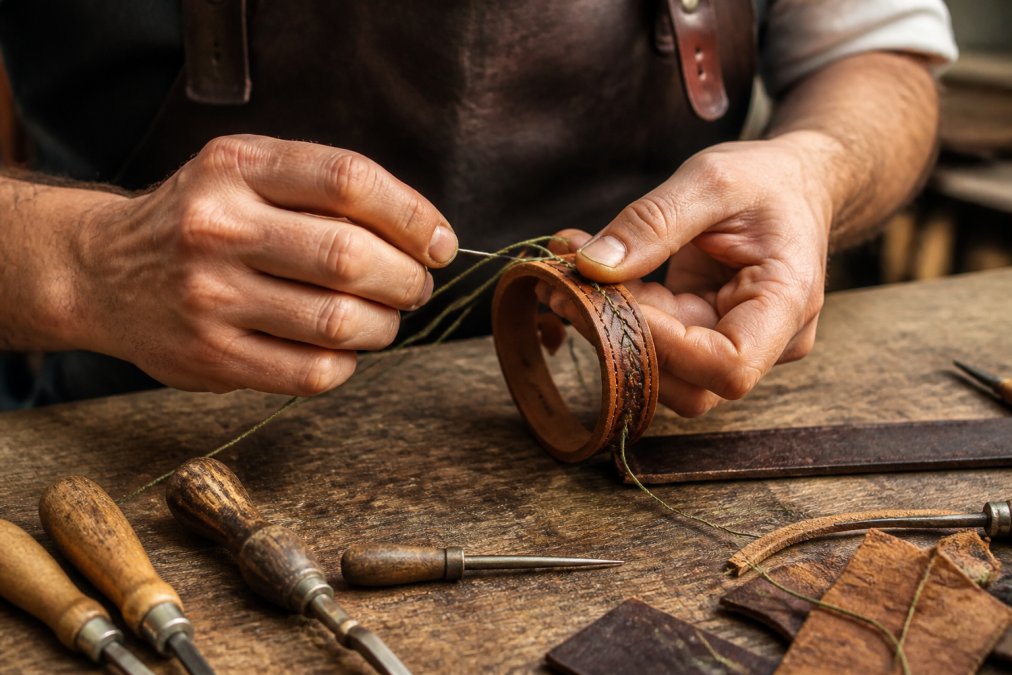
The difference between a handcrafted bracelet and a mass-produced one comes down to three things: the grade of leather, the hardware, and how the piece is assembled. Mass production optimizes for speed; artisan work optimizes for how the bracelet looks after two years of daily wear.
Full-Grain vs. Genuine Leather: Reading the Labels
Full-grain leather is the top layer of the hide, with the natural grain intact. It's the most durable cut and the only one that develops a genuine patina.
Genuine leather is a legal marketing term, not a grade. It can describe leather split to its lowest usable layer, often with a synthetic finish hiding imperfections. It's real leather, but not the same material.
Bonded leather is shredded leather fibers glued together and rolled into sheets. It's the most common material in cheap wristbands and the fastest to fall apart.
On a product label, look for "full-grain," "top-grain," or "vegetable-tanned." Those terms say something specific about durability; "genuine leather" alone says almost nothing.
Hardware That Holds Up: Stainless Steel and Sterling Silver
Hardware is where budget bracelets fail first. Plated clasps flake, magnetic closures lose their hold, and cheap rivets pull through the leather.
Stainless steel clasps resist corrosion and hold their finish through sweat, rain, and daily wear. Sterling silver adds a warmer tone and suits engraving, though it needs occasional polishing. On a well-made bracelet, the closure should feel solid and precise, not loose or gritty.
How to Style Leather Bracelets for Men
A leather bracelet is one of the few accessories a man can wear daily without it reading as costume. The trick is proportion and restraint: a cuff, a braided cord, and a beaded piece can all work, but rarely all at once.
Here's how to style leather bracelets for men without overdoing it:
- Match leather tone to your other accessories. A brown cuff pairs with a brown belt and watch strap; black leather works with black or steel. If your shoes are your only other leather, pull the bracelet toward that tone rather than adding a third brown.
- Keep the wristband proportional to your wrist. A thin cord on a large wrist looks undersized; a wide cuff on a narrow wrist looks borrowed. A cuff should span roughly from your wrist bone to the base of your hand, narrower reads delicate, wider reads armored.
- Let one piece lead. If your bracelet has a runic engraving or a prominent clasp, keep your watch simple. Two statement pieces on the same arm compete for the same glance.
- Wear it on the opposite wrist from your watch. This keeps both visible and prevents scratching. If you wear only one bracelet, the watch wrist is fine, just accept it will pick up scuffs from the case.
Layering and Stacking Etiquette
Stacking works when the pieces share a material or color story.
- Vary the width, not just the material. A 10mm cord beside a 25mm cuff creates a hierarchy the eye can follow; two bracelets of identical width look like a mistake.
- Separate leather from metal with a bead or knot. Metal sliding against a leather cuff abrades the finish over months; a wooden or stone bead buffers and adds a texture break.
- Anchor the stack to your watch. Treat the watch as the heaviest visual element and build outward: watch, thin leather cord, one accent piece. Anything past that looks like a display case.
- Match hardware finishes. Mixing brushed steel, polished steel, and brass in one stack reads as accidental. Pick one finish and repeat it.
- Respect the sleeve. A stack that works with a t-shirt looks crowded under a buttoned cuff. If you wear long sleeves often, keep the stack to two pieces so the cuff closes cleanly.
What to Avoid
A few patterns consistently undercut an otherwise good look:
- Mixing a dress watch with a chunky cuff. The formality levels clash. A slim cord bracelet is the safer pairing.
- Wearing a bracelet on each wrist plus a watch. It splits attention and reads as over-accessorized.
- Stacking across a tan line or fresh tattoo. The contrast draws the eye to the gap rather than the jewelry.
- Ignoring your dominant hand. A bracelet on your writing hand will catch on desks and paper edges; many men size down slightly or move the stack to the non-dominant wrist for that reason.
Custom Runic Leather Jewelry: Symbols That Carry Meaning
Leather Bracelet Care and Maintenance
Leather bracelet care and maintenance comes down to three habits: keep it dry, condition it occasionally, and store it away from direct sun.
Repair and Restoration for Everyday Wear
Sizing, Skin Sensitivity, and Sourcing: What Most Guides Skip
Three things get left out of most leather bracelet guides: how to measure your wrist, what to do if your skin reacts to metal, and where the leather comes from.
How to Measure Your Wrist Correctly
A few details that trip people up:
- Measure at the narrowest point, not the widest. The wrist bone is a landmark, not the measurement line. Wrap just below it, where the bracelet will actually sit.
- Measure at the end of the day. Wrists swell slightly over the course of the day and in warm weather. A morning measurement can leave you with a bracelet that feels tight by evening.
- Decide between snug and loose before you order. A snug fit (about a quarter-inch of slack) keeps a cuff from rotating and stays clear of a keyboard; a loose fit (about three-quarters of an inch) slides and reads more casual. Neither is wrong, they suit different wardrobes.
- Account for the closure. A magnetic or hook clasp adds length to the total circumference. A buckle or slide closure lets you fine-tune by a quarter-inch or so. If your wrist measures near a size boundary, the closure type matters as much as the measurement.
Skin Sensitivity and Hypoallergenic Hardware
- Nickel-plated base metal. The cheapest option and most common trigger; the plating wears through, exposing more nickel over time.
- 316L stainless steel. A common choice for people who react to nickel plating. It contains a small amount of nickel bound in the alloy, which most sensitive wearers tolerate, though not all, and it resists corrosion through sweat and rain.
- Sterling silver. A warmer tone that suits engraving and is generally well tolerated, though it needs occasional polishing and scratches more easily than steel.
- Titanium or niobium. Often chosen by people with confirmed nickel allergies. These are less common in leather bracelet hardware and typically cost more.
Leather Sourcing and Tanning Methods
Frequently Asked Questions
What is the symbolic meaning of wearing a leather bracelet for men?
Leather bracelets for men often carry personal symbolism tied to strength, endurance, and intention. In artisanal leather jewelry, symbols like runic staves or elemental marks can represent protection, prosperity, or a commitment to personal growth. Many wearers choose a bracelet during a life transition to serve as a tangible reminder of their goals. The meaning is self-defined: a minimalist cuff might signal quiet resolve, while a braided or twisted design with engraved runes can act as a way-opener for daily focus. The bracelet becomes a wearable anchor for whatever intention you assign it.
How do you care for artisanal leather jewelry to ensure longevity?
Keep leather bracelet care and maintenance simple: wipe with a dry cloth after wear, condition every two to three months with a leather balm, and avoid soaking. Water-resistant treatments help, but full-grain and vegetable-tanned leather still need drying away from direct heat. For hardware, a soft cloth removes tarnish from sterling silver, while stainless steel clasps usually just need a wipe. Store your bracelet flat or coiled in a pouch to prevent creasing. With this routine, a well-made leather bracelet can develop a rich patina and last for years of daily wear.
Can you customize the symbols on a bracelet, or do you have to choose from pre-made designs?
Mascotsbracelets offers custom runic leather jewelry where you select the symbols you want. Customization includes choosing runic staves. Check the brand's website for current options and lead times.
Are leather bracelets appropriate for formal or professional settings?
Yes, if you choose the right style. A minimalist cuff bracelet in black or dark brown full-grain leather with a slim stainless steel clasp reads as polished and understated, fitting business casual and even some formal settings. Avoid heavily braided or rugged designs with large rivets for dressier occasions. For the office, stick to one bracelet rather than a stack, and keep hardware to sterling silver or brushed steel. The key is matching the leather finish to your outfit: smooth, vegetable-tanned leather looks more refined than distressed or raw-edged pieces.